 01 — DAY
Day — Glare control
Frost only the upper zones where the sun hits, and keep the rest clear. Block direct sunlight while keeping the view. Automatic dimming with a light sensor is also available.
Multi-Zone Smart Glass System
Patent pending (Japan)
Switchable glass (PDLC smart film) is a material that turns from clear to opaque at the touch of a switch. Until now a whole pane was usually switched as one; our system divides a pane into multiple zones and lets you control the transparency of each, zone by zone, freely
The switchable film itself can come from any manufacturer. We provide the controller and control technology that drive a wide range of switchable films in multiple zones.
Applications
01
Frost the upper zones for glare control by day, the eye-level zone for privacy by night. After closing, use the opaque surface as a projection screen for promotional videos.
02
Opaque during meetings, clear when vacant — switched automatically via your booking system. You can also frost only the zone at standing height for privacy while keeping daylight from above.
03
Privacy for bathrooms and bedrooms, protection from the afternoon sun in living rooms. Linked to a light sensor, the glass can switch to glare control automatically when the sun is strong.
04
Opaque only when privacy is needed in consulting and treatment rooms. Easy to clean, with less hygiene burden than curtains.
05
Gradients and blind-like patterns for ambience. Recall preset scenes with ease to match the time of day or an event.
06
Showrooms, exhibition booths, vehicle windows and more.
Capabilities
01 — DAYFrost only the upper zones where the sun hits, and keep the rest clear. Block direct sunlight while keeping the view. Automatic dimming with a light sensor is also available.
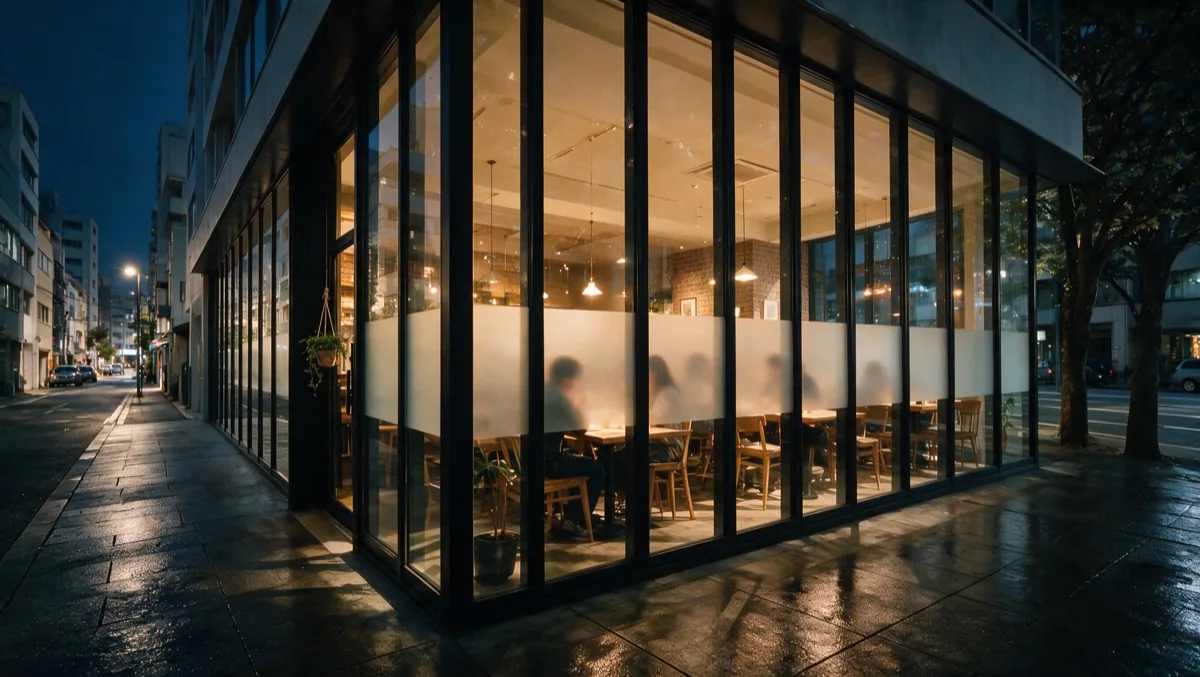 02 — NIGHT
Frost only the eye-level zone and keep the rest clear. Nobody can see in, yet you still see the lights outside. Privacy without feeling closed in.
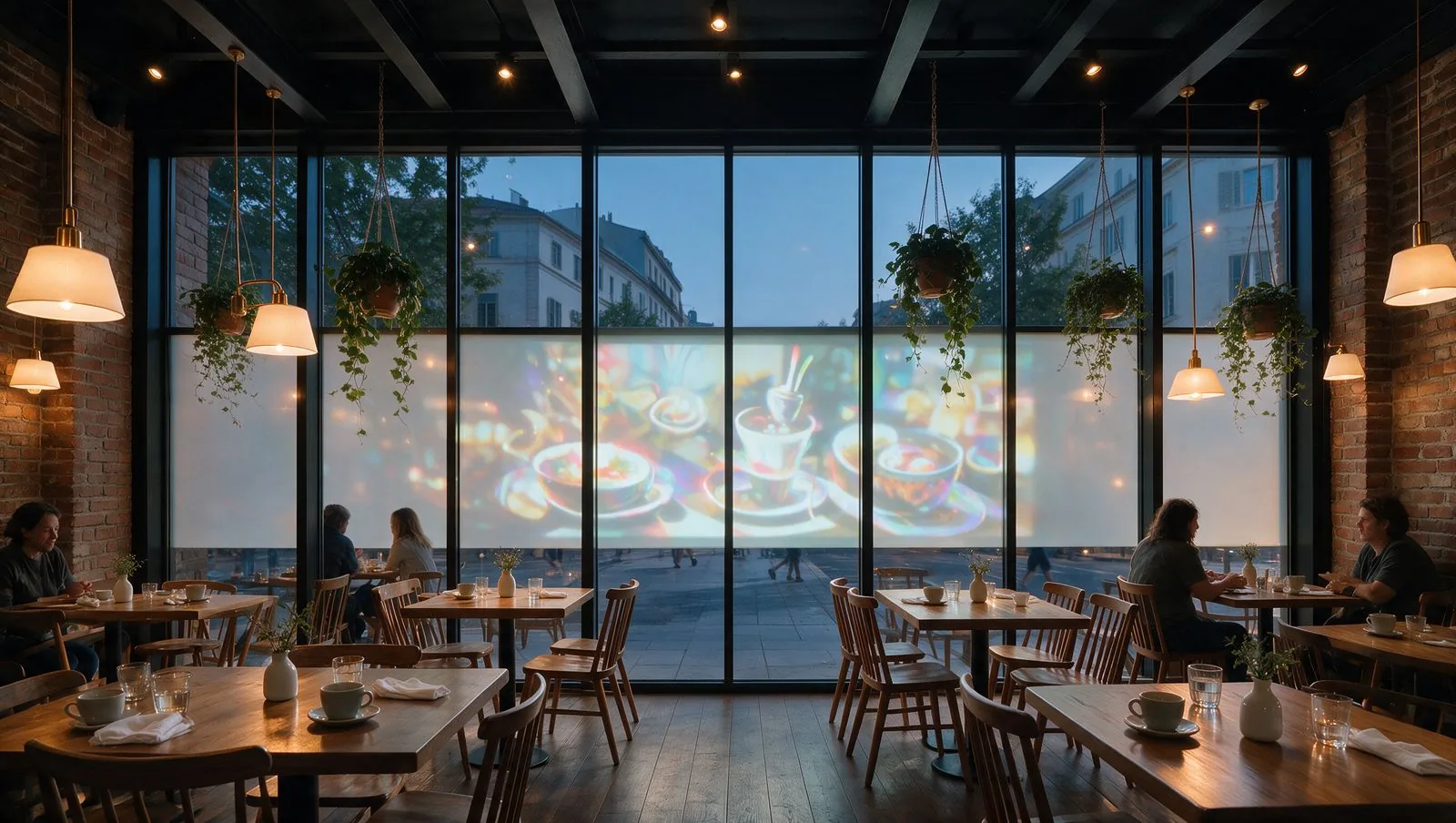 03 — SCENE
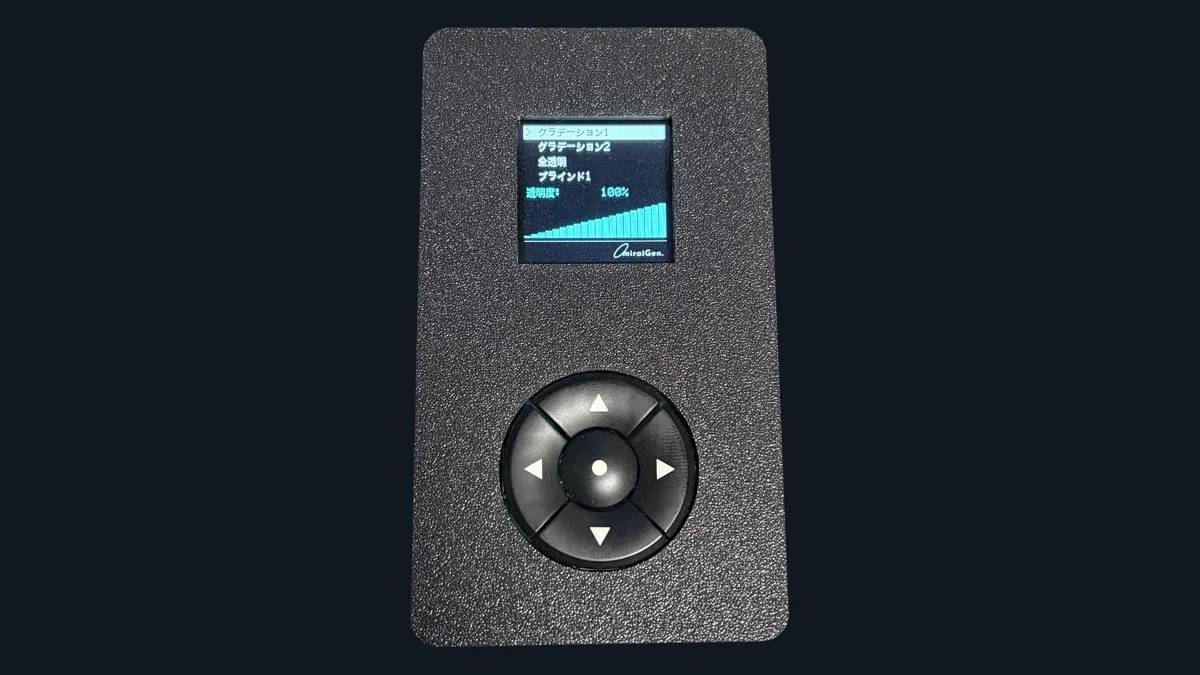
Store presets such as blind-like stripes, gradients or fully clear, and recall them per scene. A frosted band doubles as a projection screen.
Technology
Dividing switchable film into zones and controlling each one independently was not straightforward
The challenge
Only the right-most zone is meant to be clear, yet even when driven separately, voltage leaks into the neighbouring zone and makes it almost fully clear. The effect fades with distance, but the remaining zones — which should stay frosted — still turn unintentionally clear.
Why this happens, in detail — the physics behind zone interference →
miraiGen. Multi-Zone Smart Glass System (patent pending in Japan)
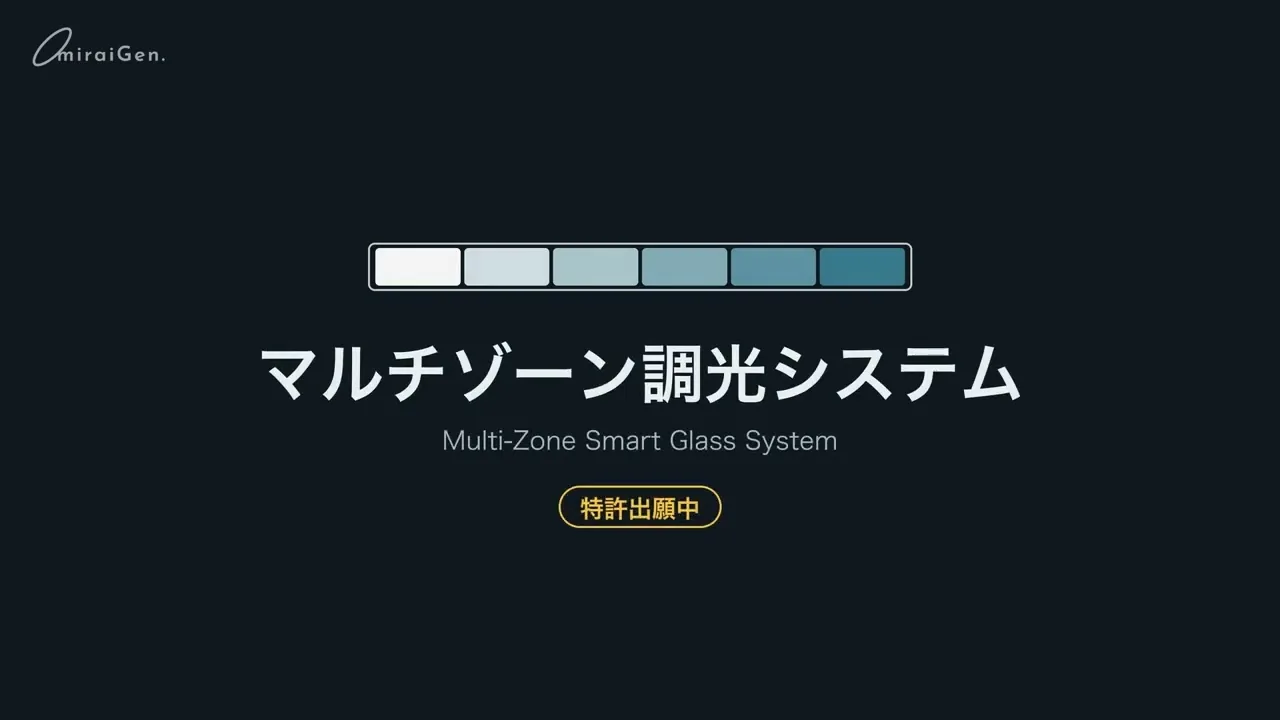
Our proprietary drive technology keeps adjacent zones from affecting each other, so each zone holds exactly the transparency you set. The diagram shows an example set individually to 0, 20, 40, 60, 80 and 100% from left to right — and it is not limited to this order: graded shading, gradients and any pattern stay stable.
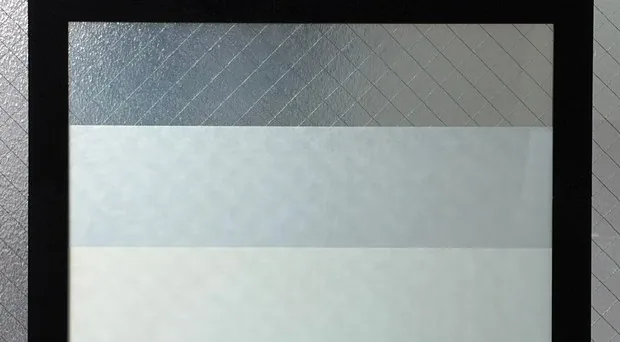
The photo shows a verification result on our prototype unit: a single zoned smart film driven by our controller with its rear common electrode left as one continuous sheet, and three adjacent zones set from top to bottom to 75% output (nearly clear), 50% (intermediate) and 0% (undriven, opaque). No current leaks across the boundaries, and each zone can be seen holding the transparency it was set to. The film is an off-the-shelf PDLC smart film simply divided into zones, with no special treatment to stop leakage.
System
Specifications are subject to change without notice.
Partnership
Try multi-zone control with your own switchable film using our evaluation kit.
Our drive technology (patent pending in Japan), in your products.
Our controller under your brand. We also welcome glazing contractors, interior firms and building-material distributors.
| Film power consumption*2 | Initial lot*4 | Standard version |
|---|---|---|
| 3 W/m² | approx. 6 m² | approx. 13 m² |
| 4 W/m² | approx. 4.5 m² | approx. 10 m² |
| 5 W/m² | approx. 3.5 m² | approx. 8 m² |
*1 The table above is a guide based on the design values of our prototype. It may change following measurements on production units.
*2 Read “film power consumption” as the value at that film’s switching voltage and a drive frequency of 60 Hz. For the same film, the higher the drive frequency the higher the power consumption (roughly proportional to frequency).
*3 The figures are a guide for 6 ch in total. Per channel, divide the zones so that the distance from the feed busbar to the farthest point is within approximately 1.2 m (at a drive frequency of 60 Hz and a transparent-electrode sheet resistance of 100 Ω/□). Beyond that, the resistance of the electrode lowers the voltage at the far end of the sheet and transmittance may become uneven. Note that this distance is the dimension across the short side of the zone (perpendicular to the feed edge); the length along the feed edge is not limited. If you let us know the sheet resistance of the film you plan to use, we will calculate the zone dimensions for your specific case.
*4 The initial shipping lot is limited to a drive voltage of 36 Vrms. If your film’s switching voltage exceeds this, please consider the standard version (shipping planned from October 2026; the schedule is subject to change).
Because the initial lot has a lower drive-voltage ceiling, delivering the same power to the film requires a larger current. The higher current increases heat dissipation in the drive circuit, so the power that can be delivered to the film — and therefore the drivable area — is smaller than for the standard version.
* These figures are planned values, not finalised specifications, and are subject to change.
Upon conclusion of a licensing or OEM agreement, the full purchase price of JPY 350,000 will be credited toward your initial order.
Notes
Taxes. Prices are quoted exclusive of tax. Export sales from Japan are zero-rated for Japanese consumption tax.
Shipping, duties and import taxes are payable by the customer.
PDLC film is to be provided by the customer.
Film compatibility. Before ordering, please provide the switching voltage of the film you intend to use. Orders can only be accepted where compatibility with the shipping version has been confirmed. The initial shipping lot is limited to a drive voltage of 36 Vrms; if your film requires a higher switching voltage, please consider the standard version (shipping planned from October 2026; the schedule is subject to change).
This evaluation kit is a prototype supplied for technical assessment only. It is provided as is, without warranty of any kind, and is not intended for installation or continuous operation. Returns and refunds are not accepted.
On arrival. If the kit is damaged in transit or fails to power up on arrival, please notify us within 14 days of delivery and we will repair or replace it. No other returns or refunds are accepted.
Who can order. This evaluation kit is supplied to product developers, system integrators and research users only. It is not sold to consumers and is not intended for resale.
Shipping destinations. We currently ship this evaluation kit outside the EU and EEA. For enquiries from the EU/EEA, please contact us directly.
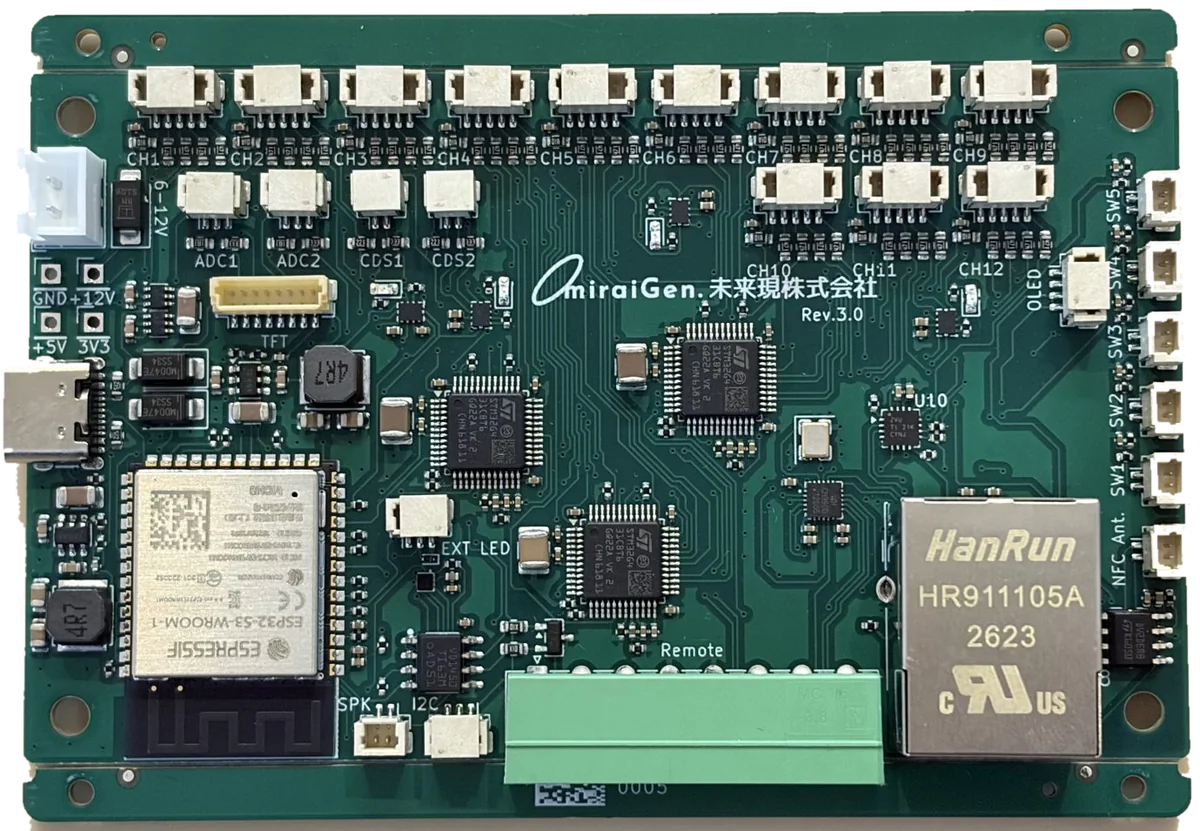
Radio compliance. The kit uses the Espressif ESP32-S3-WROOM-1 module, which holds FCC ID 2AC7Z-ESPS3WROOM1, ISED 21098-ESPS3WROOM1, an EU RED type-examination certificate and Japanese MIC certification. The assembled kit itself is not a certified end product: no FCC, CE, UKCA or other equipment authorisation has been obtained for the kit as a whole. It is supplied for evaluation only and must not be resold, incorporated into a finished product, or put into service until the approvals required in your market have been obtained. Compliance with local radio and EMC regulations is the customer’s responsibility.
Export control. Orders are subject to Japanese export control law. We may request end-use and end-user information, and may decline an order if the required confirmation or licence cannot be obtained. Re-export or diversion to military or weapons-of-mass-destruction use is prohibited.
FAQ
Yes — with film applied to existing glass, retrofitting is possible, though the routing of the cabling and the placement of the controller and switches need to be worked out. The zone layout — how many zones, and how they are divided (evenly or otherwise) — can be decided before the film is cut.
The controller is designed so its output can be tuned to each manufacturer’s film. It works with common AC-driven PDLC / PNLC switchable films. Products that require unusual drive conditions may not be compatible.
It depends on the film. Most switchable films are opaque when unpowered and clear when powered, so a power failure leaves the glass opaque. Reverse-mode films behave the other way round. We go through this in PDLC and PNLC — which one goes clear when you apply power.
Access to the system is limited to the network it is connected to, so it cannot be operated by anyone who is not on that network.
The wireless module holds certifications including FCC, ISED, EU RED and Japanese MIC. The assembled evaluation kit is not a certified end product — see the terms above. NFC uses a passive tag (ISO/IEC 15693, ST25DV04K) and does not transmit.
We currently focus on partnerships with businesses (installers, building-material distributors, film manufacturers). Private customers may be referred to an installation partner. Please use the contact form.
For installation, evaluation kits, licensing or OEM, please use the contact form.
If you only need the PDF materials, use "Request materials".